
What's my curl type?
Answer four questions and find your curl pattern in 60 seconds. Then read exactly what your type actually needs, from the studio Sydney's curly, wavy and afro community travels up to three hours to reach.
1,000+ transformations · 2A to 4C · Marrickville, Sydney
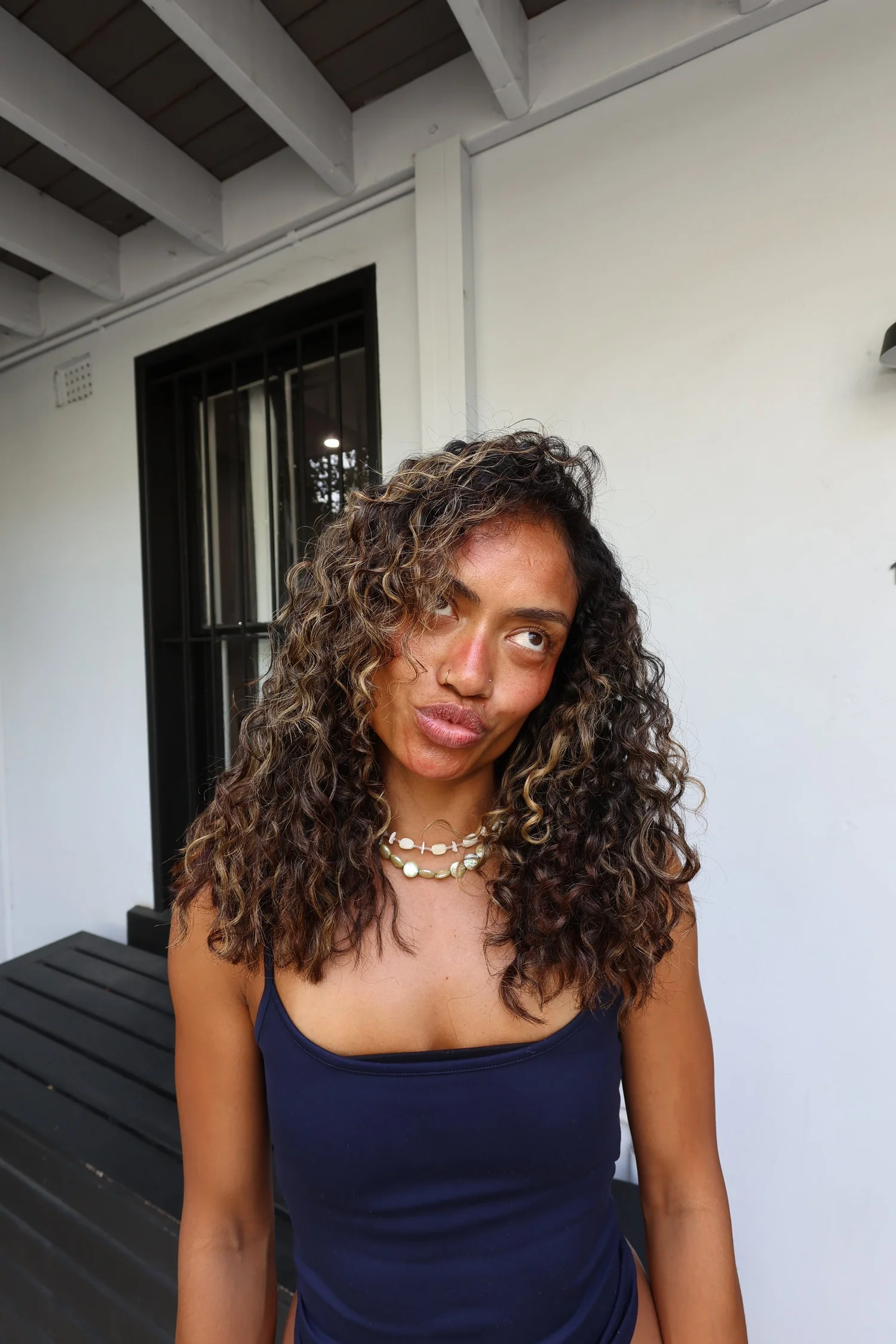 Your 3A hero photo goes here
Not sure what your curls actually are?
Most people have never been told. Answer 4 quick questions for your texture, a starter routine, and the exact service to book.
When your hair dries, what shape forms?
Think of your natural, dried texture
How wide is one single curl or coil?
Roughly the object it wraps around
How long does your hair take to dry?
This tells us your porosity, how your hair holds moisture
When you tie your hair up, how thick is the ponytail?
This tells us how much hair you have, your density
What's your biggest frustration right now?
We'll match a treatment to it
Where are you on your curl journey?
So we pitch the right first step
Curly
Every curl type, 2A to 4C
The curl chart is a shorthand, not a diagnosis. It describes the shape your hair grows in, how tight the curl is and how wide one single strand wraps. Tap any type to read it.
 2A
2AType 2A hair, loose waves
2A hair falls close to the head with a soft S-bend that starts around the mid-lengths rather than at the root. It's the finest of the wave types, which is why it drops flat so easily.
What it needs: barely anything heavy. Mousse and light gels over creams and oils, applied to soaking wet hair and left alone. Root lift matters more than definition.
The most common mistake: too much product. 2A hair is fine enough that a cream meant for coils will pull the wave straight out. Half the amount you think you need, and don't touch it while it dries.
 2B
2BType 2B hair, defined waves
2B hair has a clearer S-shape that begins closer to the root, with the top section still sitting relatively flat. It holds a wave pattern but loses it to frizz quickly.
What it needs: a light gel to set the shape, and a genuine no-touching rule while drying. Diffusing on low heat helps 2B hold far longer than drying.
The most common mistake: brushing it dry. 2B breaks into frizz the moment a brush goes through a dry wave. Detangle wet, with conditioner in, then leave it.
 2C
2CType 2C hair, waves with curls through it
2C is where waves start behaving like curls. The S-bends are wide but well formed, they begin right at the root, and you'll usually find a few actual ringlets mixed through, often at the nape or around the face. 2C hair is typically coarser than 2A or 2B and is the most frizz-prone of the wave types.
What it needs: more moisture than most wave routines allow. A leave-in conditioner under a gel, applied to very wet hair, then scrunched and left to set. 2C benefits enormously from being cut dry, because the mixed pattern means a wet cut lands unevenly once it dries back.
The most common mistake: being told you have frizzy straight hair. A huge number of 2C clients arrive believing their hair is simply unmanageable, when it's a curl pattern that was never treated as one.
 3A
3AType 3A hair, loose spiral curls
3A curls form clear, springy loops roughly the width of a soft-drink can. The pattern is well defined and consistent from root to tip, with plenty of natural volume and movement.
What it needs: moisture plus hold, without weight. Curl creams work well on 3A where they'd flatten a wave, and a gel cast over the top keeps the loop intact through the day.
The most common mistake: over-layering the cut. 3A is loose enough that aggressive layers create triangle shape and separate the curl clumps. It wants shape built around how it falls, not thinned out.
 3B
3BType 3B hair, springy ringlet curls
3B curls are springy ringlets about the width of a marker pen, tightly packed with real volume at the root. This is the pattern most people picture when they hear curly hair.
What it needs: consistent moisture and a defining product with hold. 3B has enough density to take a curl cream and a gel together, and it holds a wash-and-go for days when it's set properly.
The most common mistake: dryness read as damage. 3B loses moisture faster than looser patterns simply because of its shape. Deep hydration usually solves what people assume is breakage.
 3C
3CType 3C hair, tight corkscrew curls
3C curls are dense corkscrews roughly the width of a pencil or a straw, packed closely together with significant volume. It shrinks noticeably as it dries, hair that reaches your shoulders wet can sit near your jaw dry.
What it needs: real moisture and gentle handling. Layering a leave-in, then a cream, then a gel on soaking wet hair works better than any single product. Detangling should happen wet, with conditioner, in sections.
The most common mistake: cutting it wet. 3C shrinks so much that a wet cut almost always comes up shorter and less balanced than intended. Cutting dry, in the natural curl, is the only reliable way to shape it.
 4A
4AType 4A hair, tightly coiled
4A hair forms small, visible coils about the circumference of a straw, with a clear defined pattern. It holds moisture less easily than curlier patterns and shrinks substantially.
What it needs: layered moisture and low manipulation. Water first, then a leave-in, then a cream or butter to seal it in. Styling in sections rather than all over makes a large difference.
The most common mistake: treating shrinkage as a problem to fix with heat. Shrinkage is a sign of healthy elasticity. Stretching it with heat repeatedly is what causes the damage people are trying to avoid.
 4B
4BType 4B hair, zig-zag coils
4B hair bends in sharp zig-zags rather than rolling in a coil, with less visible curl definition and a cottony texture. It's dense, shrinks dramatically, and is the most fragile pattern at the bends.
What it needs: moisture, sealing, and as little tension as possible. Shingling product through small sections defines the pattern where a wash-and-go approach won't. Protective styling between appointments genuinely helps.
The most common mistake: forcing definition. 4B doesn't clump into ringlets and doesn't need to. Working with the pattern's density and volume produces better results than chasing a curl shape it doesn't grow in.
 4C
4CType 4C hair, dense coils, maximum shrinkage
4C hair has the tightest pattern, coiling so closely that the curl is often not visible until it's wet or product is in it. It's dense, extremely prone to dryness, and can shrink by 70 percent or more, length you can only see when it's stretched.
What it needs: water as the first step, every time, then a heavier sealant to hold that moisture in. Deep conditioning is not a treat for 4C, it's maintenance. Detangling should be done wet, slowly, in small sections, with plenty of slip.
The most common mistake: assuming it doesn't grow. 4C almost always grows at a normal rate, the shrinkage hides it, and breakage from dry handling removes the length before it shows. Consistent moisture and low manipulation reveal length that was already there.
Your curl type is a starting point, not an answer.
Curl type tells us the shape your hair grows in. It doesn't tell us the three things that change your routine most: how thick each strand is, how quickly your hair absorbs and loses water, and how much of its structure has been affected by colour, heat or years of being cut wet.
That's why two people with identical 3B curls can need completely different products. And it's why our method doesn't change from type to type, the five steps are the same for every curl. What changes is how much product suits your texture, and that's something we work out with your hair in front of us.
So use your result as a shorthand. Then let someone read your actual hair.
Ready to see your type at its best?
Every appointment starts with understanding your texture, and every cut and treatment finishes with a professional curl style, you never leave with wet hair. Your first visit can be a free curly consultation: we look at your texture, talk through your goals, and build a plan, with no commitment to book.
Book a free consult See all services and pricing →Curl type questions, answered
How do I know what curl type I have?
The easiest way is to look at the width of one single curl or coil when your hair is clean and dried: as wide as a soft-drink can is a wave, as wide as a marker is a curl, as narrow as a pencil or straw is a coil. That underlying shape is your curl type. The right products and technique don't flatten it, they enhance it, bringing out more definition and often more curl than you see day to day. Our 60-second quiz at the top of this page walks you through it.
Can I have more than one curl type?
Almost everyone does. It's normal to have looser waves through the crown and tighter curls at the nape or around the face. Go by the pattern that covers most of your head, and treat the tighter sections with a little more moisture.
What's the difference between 2C and 3A hair?
2C is a wide, well-formed S-wave with a few loose ringlets mixed through it. 3A forms a complete spiral loop, roughly the width of a soft-drink can, consistently across the head. If you can see actual loops rather than bends, you're in 3A.
Does my curl type determine which products I should use?
Partly. Type tells you roughly how much moisture and hold your shape needs, but how fine or coarse your hair is, and how quickly it absorbs water, matters just as much. Two people with the same type often need different products.
Should curly hair be cut wet or dry?
Dry, in its natural curl. Curly, wavy and afro hair shrinks as it dries, so a shape measured wet lands shorter and less balanced than intended. We cut every head of hair dry, in the curl, so what you see in the chair is what you walk around with.
Do you cut all curl types?
Yes, wavy, curly and afro, from 2A through 4C, including children's hair and men's cuts. Every technique we use is built for textured hair rather than adapted from straight-hair training.